We have just returned from Iran. It is considered a spring trek when I was there, and summer has just began when I flew back home. In the heart of Tehran city the weather had been dry and hot. It was not as humid as Singapore making it more bearable. Tehran’s climate can be generally described as mild in the spring and autumn, hot and dry in the summer, and cold in the winter.
Following the 1979 Iranian Revolution, Iran became an Islamic Republic. Iran is a country with a dress code and respecting Islamic rules including “Hijab” or the Islamic dress-code is a necessity. However such rules are not observed strictly, especially for tourists and foreigners. Basically, the rules are quite simple: for men, no short pants or extreme short sleeve and tight shirts. For women, head and hair must be covered, and it is also necessary to wear something loose to cover the body. The dress code for women made my trips to Iran more interesting, and this has been my 5th visit to Iran since 2002.
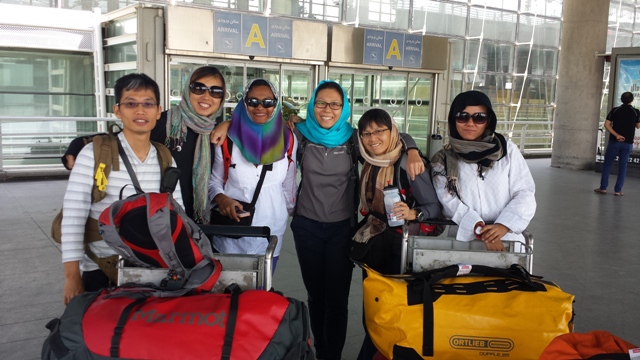
All “dressed up” at the Imam Khomeini International Airport.
Tehran is elevated at about 1170m above sea level. The base of Mount Damavand is at about 3000m, and the mountain hut is at 4250m. In view of the rapid altitude gain, we went for a day hike to reach 2700m, and stayed two nights at the base of the mountain before arriving at the mountain hut.

At the base of Shirpala (Touchal)
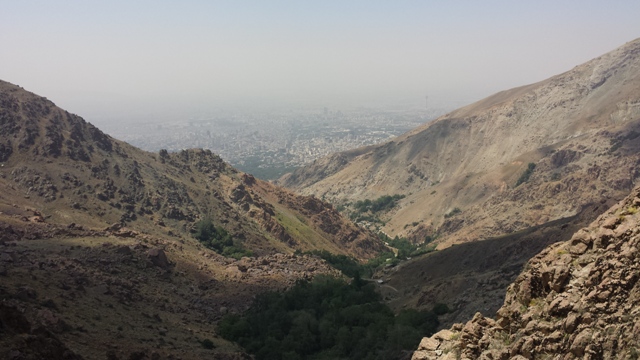
Overlooking the polluted Tehran city

Some parts of the trail is steep and requires scrambling on all four.
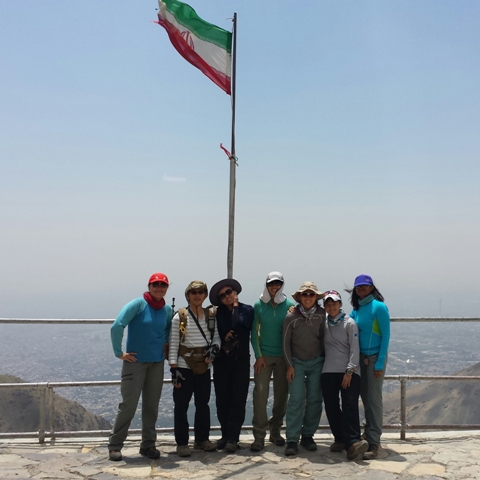
Arriving at a high point with Iran’s flag flying high.
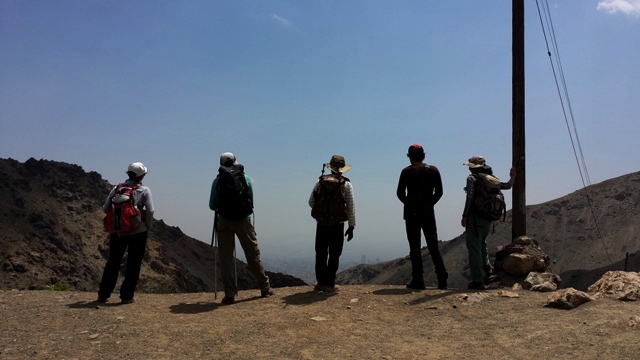
Descending from Shirpala, looking forward to the climb ahead.
Mount Damavand is a volcano located in the central part of Alborz Mountain Range in north of Iran on the southern coast of the Caspian Sea. It is the highest point of Iran, also the highest volcano in Asia, the highest summit in the Middle East and the second highest volcano in the northern hemisphere. (Kunlun Volcanic Group (China) is the highest volcano in the northern hemisphere, 130m higher than Damavand. Mt Damavand has the official title of being the highest volcano in Asia, not Kunlun as they are not considered as mountains.)

Mount Damavand in spring.
After spending two nights at the base of the mountain (Goosfan Sara) to acclimatize, we trekked up to the mountain hut (Barghahe Sevom) to prepare for the summit attempt.

Camping at Goosfan Sara
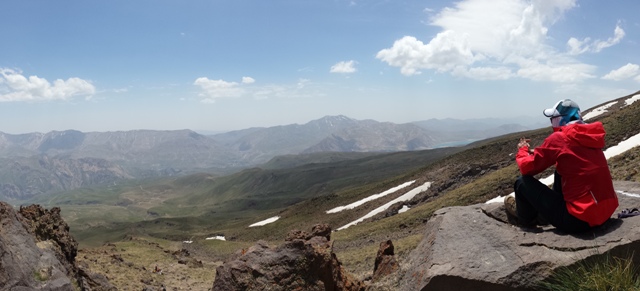
A good view of Lar National Park, and Lar lake.
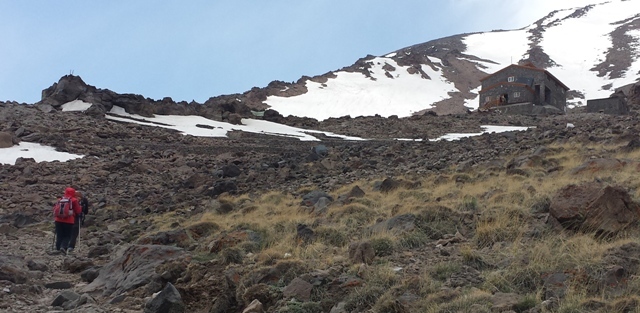
The mountain hut at 4250m a.s.l. (Barghahe Sevom)
From the mountain hut, it will be a 1360m grueling ascent to the top of Mt Damavand. The trail up was not difficult, but the altitude made it tough. The trail consist of some loose gravels, scree slopes, scrambling rocks, and snow trail left from the winter.

Leaving the mountain hut for the summit.
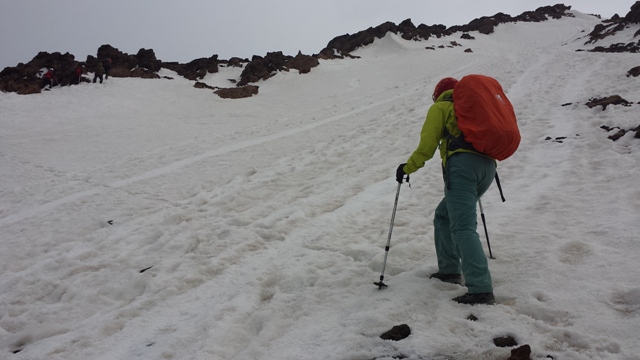
Walking on snow is part of the challenges on Mt Damavand.
On an average, it takes between 5 and 8 hours to reach the summit from the mountain hut. Ultimately, it is your fitness, acclimatization, attitude, and your determination to reach the summit and return safely; and of course a little luck for everything!

At the summit of Mt Damavand on 19th June 2014.
This has been my third successful ascent on Mt Damavand, once in spring, and twice in summer. Based on my observation, climbing in spring has more snow than in summer. Although we were already in the last week of spring, looks like the snow will only melt when summer is in full swing. The snow has not been a real threat to us, it is the altitude and the sulfuric filled environment that made climbing harder. To summit is a bonus, the real adventure lies in the journey and it is only in those who experienced it could relate to it.
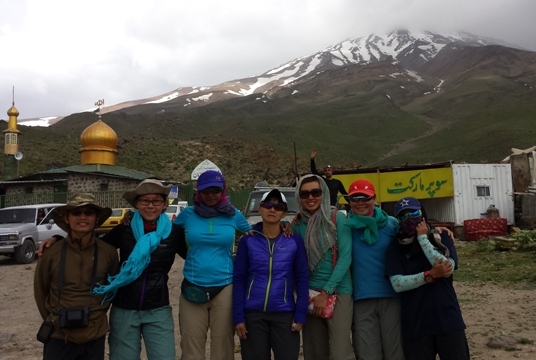
The team arrived at Goosfan Sara in good spirit.
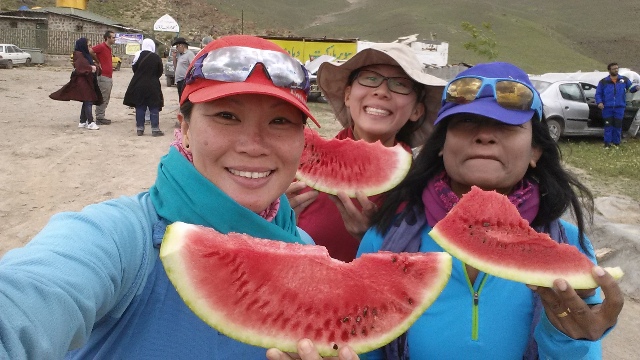
We were treated with sweet watermelon to quench our thirst.
If you are considering to trek to Mt Damavand, we will go back in June 2015 (http://aceadventure.org/)
 Joanne's climb